For most Australian businesses, the question about compliance management software isn’t whether it’s worth the cost — it’s whether they’ve properly accounted for the cost of not having it. The ROI calculation for compliance software isn’t a comparison between a software subscription and nothing. It’s a comparison between a software subscription and the realistic probability-weighted cost of compliance failure, plus the measurable time cost of manual compliance processes, plus the opportunity cost of compliance uncertainty in business development.
When those numbers are properly assembled, compliance management software typically pays for itself within the first year for any Australian business with meaningful regulatory exposure. This article works through that calculation with specifics relevant to the Australian regulatory environment.
The Cost of Non-Compliance in Australia: The Numbers
Australian regulatory penalties have escalated significantly over the past five years. The enforcement posture of the Fair Work Ombudsman, OAIC, ASIC, and Safe Work Australia regulators has shifted from primarily educational to increasingly punitive. Understanding what’s at stake is the starting point for any ROI analysis.
Fair Work Act Penalties
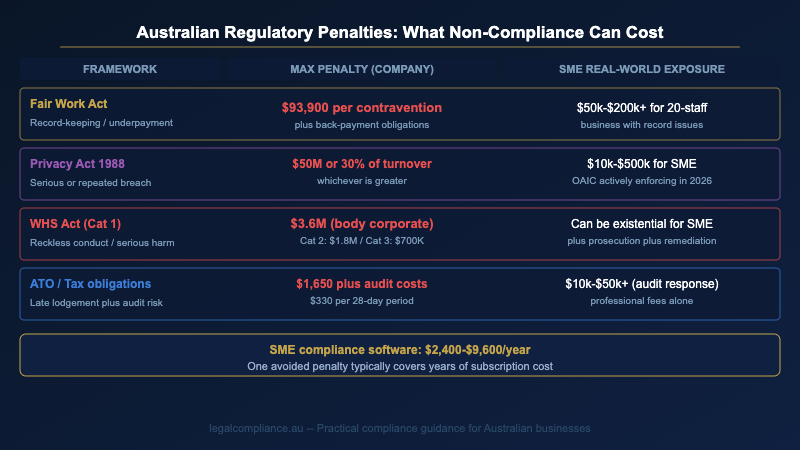
The Fair Work Ombudsman is the most active regulator for Australian SMEs. Civil penalties for breaches of the Fair Work Act reach $18,780 per contravention for an individual and $93,900 per contravention for a company (2026 figures, indexed annually). Record-keeping contraventions — among the most common SME compliance failures — can attract penalties per employee per contravention period. A business with 20 employees that has failed to maintain compliant records across a 12-month period faces potential penalties that easily exceed $100,000 before any back-payment obligations are calculated.
The FWO’s compliance partnership program and audit activity means small businesses in retail, hospitality, cleaning, and labour hire face a genuinely elevated enforcement risk. “We didn’t know” is not a defence — the FWO treats compliance as the employer’s responsibility regardless of knowledge.
Privacy Act Breaches
The Privacy Act 1988 civil penalty regime was substantially strengthened by the 2022 and 2024 amendments. Serious or repeated breaches now attract penalties of up to $50 million for companies, or three times the benefit obtained from the breach, or 30% of Australian turnover — whichever is greater. For SMEs, the relevant range is lower but still significant: penalties in the tens of thousands are now routine for smaller privacy breaches, and the OAIC’s active enforcement agenda in 2026 reflects a regulator that has moved decisively beyond warnings.
The Notifiable Data Breaches scheme requires notification to the OAIC and affected individuals within 30 days of identifying an eligible breach. A business without a documented privacy compliance program faces both the regulatory penalty for the breach itself and potential additional liability for failing to maintain adequate processes — a compounding exposure.
WHS Penalties
Work health and safety penalties are among the most severe in Australian regulatory law. Category 1 offences (reckless conduct) carry penalties up to $3.6 million for a body corporate and can include imprisonment. Category 2 offences (failure of duty of care resulting in serious harm) reach $1.8 million. Category 3 offences — failure to comply with a duty of care where no injury results — still carry penalties up to $700,000 for a company. In the context of SME compliance management, the cost of a WHS compliance failure can be existential.
Tax and ASIC Obligations
ATO late lodgement penalties accumulate at a rate of $330 per 28-day period (up to 5 penalty units, capped at $1,650 for small entities). More significantly, failure to maintain adequate records creates exposure to ATO audit risk — the cost of which includes not just any tax adjustments identified but professional fees for the audit response, which commonly exceed $10,000–$50,000 for a substantive audit engagement.
The Time Cost of Manual Compliance Management
Beyond the risk of regulatory penalties, compliance management software generates measurable time savings that represent direct cost reduction. Quantifying this requires an honest assessment of how much time manual compliance processes actually consume.
Monthly Maintenance Time
A business managing 40–60 compliance obligations in a spreadsheet typically expends 8–12 hours per month in maintenance activities: updating compliance status, chasing obligation owners for updates, reviewing whether obligations need to be updated following regulatory changes, and preparing management reports. At an all-in cost of $80–$120 per hour for the time of whoever owns the compliance function (whether that’s an operations manager, HR manager, or the business owner), the monthly cost of manual compliance management runs to $640–$1,440 per month — before any audit preparation or evidence compilation is included.
Regulatory Change Monitoring
Australian regulatory change is constant. Monitoring it manually — checking the Fair Work Commission’s Modern Awards updates, OAIC enforcement guidance, Safe Work Australia guidance, ASIC regulatory updates, and ATO changes — requires systematic effort that most small businesses simply don’t sustain. The result is that regulatory changes go unnoticed until something goes wrong. Compliance software with Australian regulatory monitoring eliminates this monitoring burden entirely, surfacing relevant changes automatically and linking them to affected obligations.
Audit Preparation Time
When a regulator visits, a client requests evidence of compliance, or an investor asks for a compliance status report, a business managing compliance via spreadsheet typically requires 10–40 hours of intensive preparation — locating documents, compiling evidence, reconstructing histories from email threads, and producing reports from scratch. Compliance software reduces this to under an hour. For a business that faces this situation even twice per year, the time saving alone — at senior staff rates — can exceed the annual cost of the software subscription.
How to Calculate Compliance Software ROI
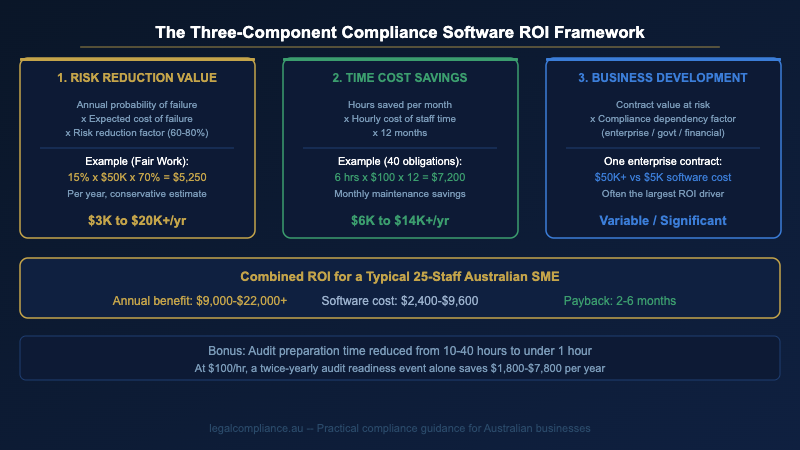
The ROI calculation for compliance software has three components: risk reduction value, time cost savings, and business development value.
Risk Reduction Value
Risk reduction value is calculated as: (Annual probability of compliance failure) × (Expected cost of failure if it occurs) × (Reduction in probability from improved compliance management).
For a business managing Fair Work obligations manually, a conservative estimate might be: 15% annual probability of an underpayment or record-keeping issue being identified × $50,000 expected cost (penalty + back-payment + professional fees) × 70% risk reduction from systematic compliance management = $5,250 annual risk reduction value.
Businesses in regulated industries — financial services, health, NDIS, real estate — with materially higher failure probabilities and materially higher penalty exposures produce substantially larger numbers. A financial services business with AML/CTF obligations, Privacy Act exposure, and ASIC regulatory requirements can reasonably calculate risk reduction values of $20,000–$100,000 annually.
Time Cost Savings
Time cost savings are typically the easiest component to quantify because they’re directly calculable: (Hours per month saved by automation) × (Hourly cost of staff time) × 12 months.
A conservative estimate for a 30–50 obligation register: 6 hours per month saved × $100 per hour × 12 months = $7,200 annual time saving. This alone exceeds the annual subscription cost of SME-tier compliance platforms like Lahebo.
Business Development Value
Business development value is the hardest to quantify but increasingly significant: the value of deals won, contracts retained, or clients secured because the business can demonstrate a documented compliance program. Enterprise clients, government procurement, and financial services counterparties increasingly require compliance evidence as part of onboarding. A single contract that would have been lost without a demonstrable compliance program can generate more value than years of software subscription costs.
What the Numbers Typically Show
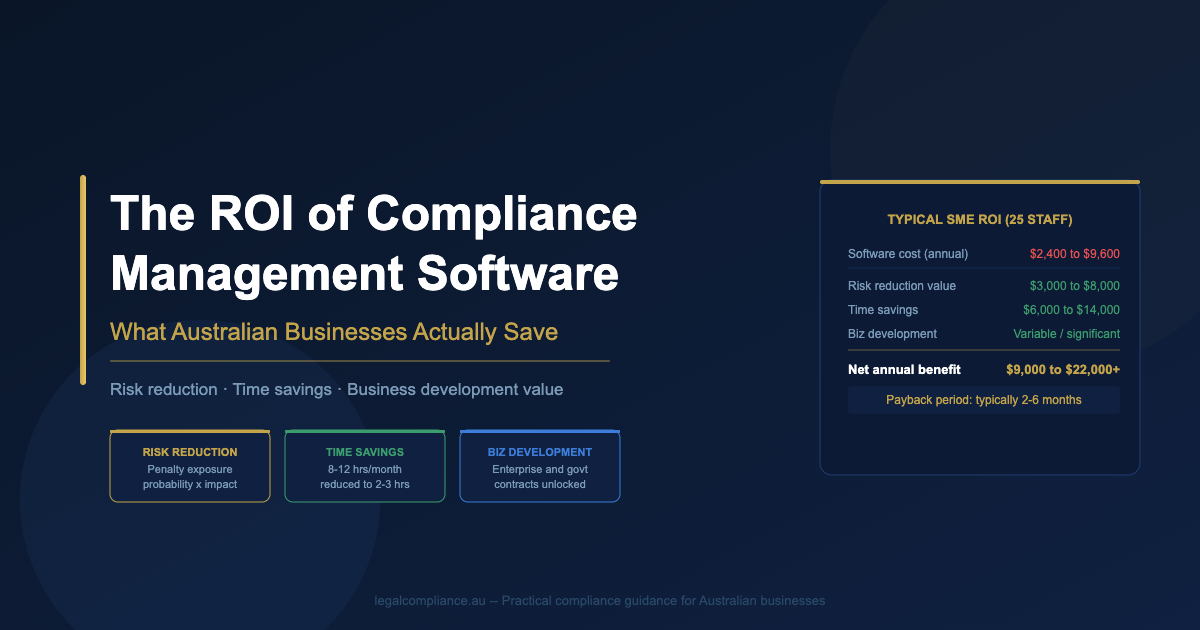
Pulling these components together for a representative Australian SME — 25 staff, mixed regulatory footprint (employment, WHS, privacy, basic corporate obligations), managing 40 obligations:
- Risk reduction value: $3,000–$8,000 per year (conservative, based on a business without high-risk industry exposure)
- Time cost savings: $6,000–$14,000 per year (6–12 hours per month at $80–$100/hour)
- Business development value: Variable, but a single enterprise or government contract requiring compliance evidence can be worth $50,000+ annually
- Total measurable ROI: $9,000–$22,000 per year against a software cost of $2,400–$9,600 per year
Even at the conservative end, the ROI is strongly positive. The payback period for SME-tier compliance software is typically measured in months, not years. Lahebo’s own analysis of this calculation — available in their GRC software ROI business case guide — provides a detailed worked example with specific calculations for different business types and sizes.
The ROI Case for Regulated Industries
For businesses in regulated industries, the ROI calculation is materially stronger — because both the probability of regulatory scrutiny and the cost of failure are significantly higher.
Financial Services (AML/CTF, ASIC)
AML/CTF Tranche 2 obligations from 1 July 2026 bring tens of thousands of new reporting entities — accountants, lawyers, real estate agents — into AUSTRAC’s regulatory perimeter. For these businesses, purpose-built compliance software isn’t a convenience; it’s a necessity for meeting the documentation and monitoring requirements the new regime demands. The alternative is either a manual system that creates significant regulatory risk or a compliance consultant engagement that typically costs more than a software subscription for equivalent coverage.
Health, NDIS, and Aged Care
The health, NDIS, and aged care sectors face compliance frameworks where a single serious failure can result in registration suspension — an existential outcome for the business. The ROI calculation here is straightforward: the value of maintaining registration (the entire revenue of the business) divided by the probability that inadequate compliance management leads to a serious breach. Even a 1% annual probability against a $2 million revenue business produces a risk reduction value of $20,000 — multiples of the software cost.
Construction and Manufacturing (WHS)
In high-risk WHS environments, the cost of a Category 1 or 2 offence makes the ROI calculation almost a formality. The relevant question isn’t whether compliance software is cost-effective — it clearly is when the alternative exposure runs to millions of dollars. The question is whether the software in use is genuinely fit for purpose in managing WHS-specific obligations systematically.
The Hidden ROI: What Compliance Software Prevents
The ROI analysis above focuses on quantifiable outcomes. But compliance software also delivers value through outcomes that are difficult to quantify but real: the compliance breach that was caught before it became reportable because the system flagged an obligation overdue for review; the regulatory change that was actioned before the business inadvertently fell out of compliance; the audit that concluded without findings because the evidence was organised and immediately producible.
These prevented outcomes don’t appear in any ROI calculation — because their value is the absence of a cost rather than the presence of a saving. But they’re the primary reason experienced compliance managers in larger organisations treat compliance software as non-negotiable infrastructure rather than a discretionary expense.
Choosing Software That Maximises ROI
Not all compliance software delivers the same ROI. The features that drive the most value for Australian SMEs are:
Australian regulatory monitoring — The time saving value and risk reduction value of compliance software is dramatically reduced if regulatory changes relevant to your business aren’t captured automatically. A platform that monitors Fair Work Commission updates, OAIC guidance, Safe Work Australia, and ASIC delivers far more ROI than a generic global platform that requires manual regulatory monitoring alongside the software.
Evidence attachment — The audit preparation time saving only materialises if evidence is actually attached to obligations in the system. A platform that supports this workflow converts the 10–40 hours of audit scramble into under an hour.
Automated reminders — Compliance obligations not reviewed on schedule are compliance obligations at risk. The automated reminder function is what prevents the “fell through the cracks” failure mode that characterises spreadsheet-based compliance management.
Fast time-to-value — A platform that takes months to implement and requires ongoing IT support consumes ROI in implementation costs before it generates any. For SMEs, the right platform is one that’s operational within days and self-service from the outset.
Frequently Asked Questions
How do I build a business case for compliance software internally?
The most effective internal business case follows the three-component framework: risk reduction value (probability of failure × expected cost × risk reduction factor), time cost savings (monthly hours saved × hourly rate × 12), and business development value (contracts or clients that require documented compliance). Calculate each component conservatively, compare to the software subscription cost, and present the payback period. For most Australian SMEs, the payback period is under 12 months at conservative estimates.
Is the ROI different for small vs. mid-size businesses?
The ROI is typically stronger for mid-size businesses (50–200 staff) because both the regulatory exposure and the time cost of manual processes scale with business size. However, the ROI is positive for SMEs in most scenarios — the question for very small businesses (under 15 staff, under 20 obligations) is primarily timing: is the regulatory exposure and process cost yet significant enough to justify dedicated software, or is a well-structured spreadsheet sufficient for now?
What if we’ve never had a compliance failure — does the ROI still hold?
Yes — for two reasons. First, the absence of a past compliance failure doesn’t reduce the probability of a future one; it may simply reflect that no regulator has yet looked closely. Second, the time cost savings component of the ROI holds regardless of compliance history. If the business is spending 8–12 hours per month on manual compliance management that software would reduce to 2–3 hours, that saving exists whether or not a breach has ever occurred.
Does compliance software reduce insurance premiums?
Potentially, depending on the insurer and the type of cover. Some professional indemnity and D&O insurers offer premium adjustments for businesses that can demonstrate a documented compliance program. The mechanism is that a documented program reduces the insurer’s assessment of the likelihood of a claim. This is worth discussing with your broker, though it shouldn’t be the primary basis for the ROI calculation.
The Bottom Line on Compliance Software ROI
The ROI of compliance management software for Australian businesses is almost universally positive once the full cost picture is accurately assembled. The direct time savings alone typically justify the subscription cost for businesses managing more than 25–30 obligations. Add risk reduction value and the business development benefits of a documented compliance program, and the question becomes less “can we afford compliance software” and more “why haven’t we done this sooner.”
For Australian businesses ready to convert that ROI into action, the platform decision matters. A tool that understands the Australian regulatory environment, monitors relevant legislative changes automatically, and can be set up without an IT project delivers far greater ROI than a generic global platform that requires significant configuration to match Australian obligations. For the SME and mid-market segment, that means starting with a platform built specifically for the Australian context — and getting the ROI clock running from day one.