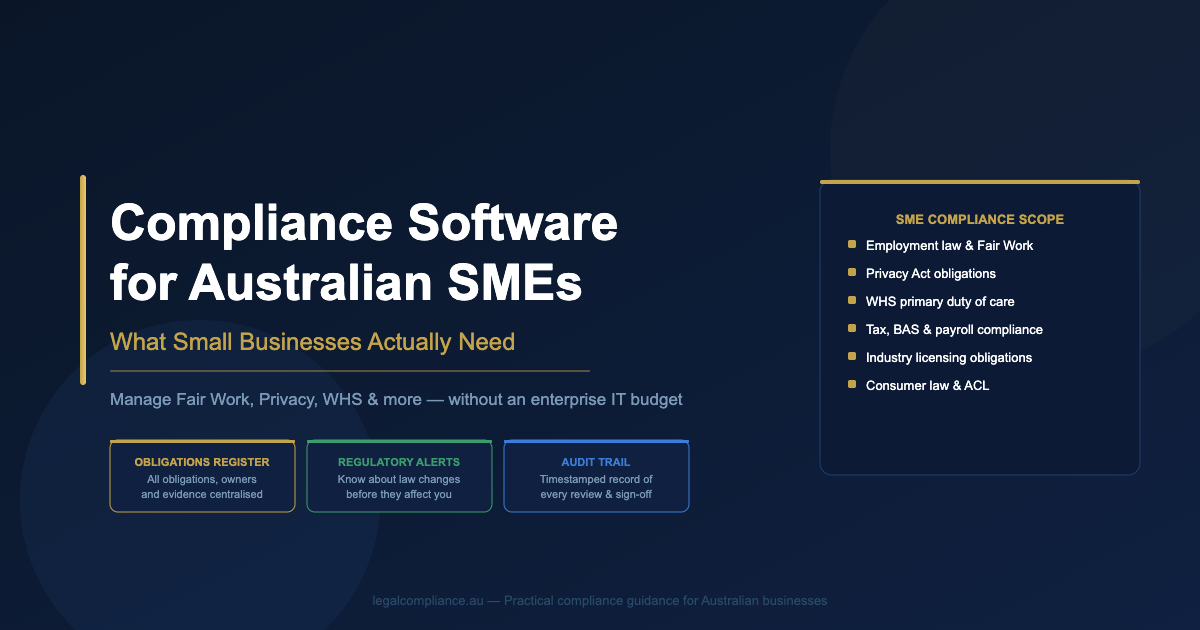
Small Australian businesses face a compliance paradox. The regulatory obligations are significant — Fair Work Act minimum conditions, privacy requirements under the Australian Privacy Principles, WHS primary duty of care, consumer law, tax and superannuation obligations — but the resources to manage them are limited. A 15-person business doesn’t have a compliance team. Often, it doesn’t have a dedicated compliance manager. Compliance gets managed in the margins of someone’s actual job.
The result, too often, is a compliance register that lives in a spreadsheet that hasn’t been reviewed since it was first built, obligations that have no named owner, and evidence of compliance scattered across email threads and shared folders. It works until a regulator asks — and then it doesn’t.
Compliance software for Australian SMEs has evolved significantly. Platforms that once required enterprise IT budgets and implementation teams now come in configurations that a small business can set up and run without specialist support. This guide explains what small Australian businesses actually need from compliance software, and how to find it.
What Does “Compliance Software” Mean for a Small Business?
For an enterprise, compliance software is a GRC platform — a complex system integrating risk management, audit, compliance obligations, policy management, and incident reporting across a large organisation with multiple entities and jurisdictions. That’s not what a small business needs.
For an Australian SME, compliance software means one thing: a platform that replaces the spreadsheet approach to compliance management with something that actually works — a centralised obligations register with named owners, evidence linkage, regulatory change alerts, and an audit trail that can be produced quickly if a regulator comes knocking.
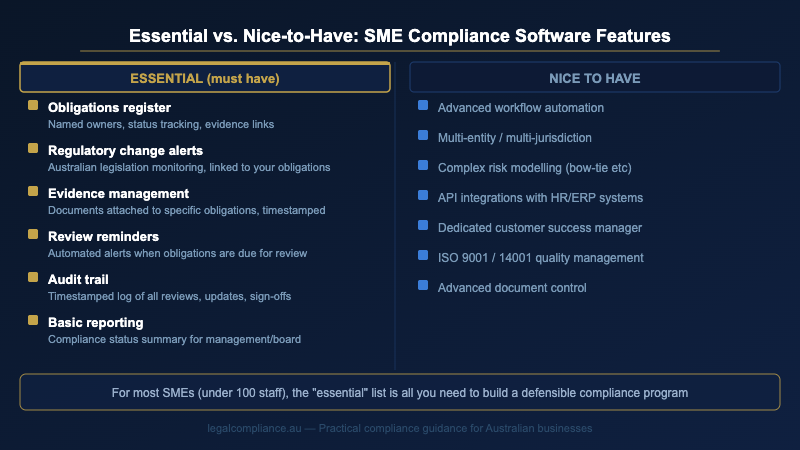
The core functionality a small business needs is:
- An obligations register that records every applicable law and regulation, the specific obligations it creates, who owns each obligation, and the current compliance status
- Evidence attachment — the ability to link specific documents, records, and outputs to specific obligations
- Automated review reminders — so obligations get reviewed on schedule rather than when someone remembers
- Regulatory change monitoring — alerts when relevant Australian legislation or regulatory guidance changes
- A simple audit trail — a timestamped record of every update and review
Everything beyond this — workflow automation, multi-entity management, complex risk modelling, API integrations — is nice to have but not essential for a business under 50 staff.
The Compliance Challenges Specific to Australian SMEs
Australian SMEs face several compliance challenges that are specific to their size and context:
No Dedicated Compliance Owner
In a small business, compliance falls to whoever has the closest relevant role — the operations manager, the HR person, the business owner. This creates two problems: compliance becomes a lower priority than operational work, and when that person leaves, their compliance knowledge walks out with them. Purpose-built software solves this by embedding compliance ownership in a system rather than a person — so when staff change, the register and its ownership assignments remain.
Keeping Up With Regulatory Change
Australian regulatory change is constant. 2026 alone has brought AML/CTF Tranche 2 obligations affecting tens of thousands of new businesses from 1 July, payday superannuation changes, and active OAIC enforcement activity. Small businesses typically learn about regulatory changes late — often after they’re already in breach. Compliance software with Australian regulatory monitoring eliminates this lag by surfacing relevant changes proactively and linking them to the specific obligations in your register that are affected.
Producing Evidence Quickly
When the Fair Work Ombudsman visits, or ASIC sends a request, or a client asks for evidence of your privacy controls — a small business needs to produce that evidence quickly. If compliance is managed via spreadsheet, this typically requires a scramble through email threads, shared drives, and memory. Compliance software with evidence directly attached to obligations eliminates the scramble — the evidence is there, timestamped, and linked to the specific obligation.
Board and Management Reporting
Even small businesses with boards or external investors are increasingly expected to provide compliance status reporting. Manually compiling this from spreadsheets takes time that small businesses can’t spare. Compliance software generates this reporting automatically — a quarterly compliance status report that would take hours to compile manually takes minutes to generate.
Key Features to Look for in SME Compliance Software
Australian Regulatory Coverage
The platform should understand Australian obligations — Fair Work Act, Privacy Act, WHS legislation, ASIC and AUSTRAC frameworks — not just provide a generic template that requires you to figure out which Australian laws apply. The best Australian SME compliance platforms either pre-populate relevant obligations or provide Australian-specific templates as a starting point.
Ease of Setup Without IT Support
A small business compliance platform should be set up and operational within days — not months. If it requires an implementation consultant, a data migration project, or IT department involvement to get running, it’s the wrong tool for a small business. Look for platforms with simple onboarding, pre-built Australian compliance templates, and self-service configuration.
Accessible Pricing
SME compliance software should be priced as a business expense rather than a capital investment. Monthly subscription pricing in the $200–$800/month range is appropriate for most small businesses. Avoid platforms with per-seat pricing that becomes expensive as you add owners to obligations, or implementation fees that equal six months’ subscription cost.
Regulatory Change Notifications
This feature matters more for small businesses than any other — because small businesses are least likely to have a systematic regulatory monitoring process in place. The platform should monitor Australian legislative and regulatory change and alert you when something relevant to your obligations changes. This isn’t a nice-to-have; it’s what makes the difference between a compliance program that stays current and one that silently falls out of date.
What Australian SMEs Are Managing: The Obligation Landscape
The compliance obligations that most Australian SMEs need to manage fall into several categories:
Employment Law Obligations
Fair Work Act minimum conditions, Modern Award obligations, superannuation guarantee timing and rate, payroll tax registration and lodgement thresholds, long service leave obligations, record-keeping requirements (employee records, pay slips, time and wages records), and workplace policies. These are the obligations with the highest enforcement activity for small businesses — the Fair Work Ombudsman actively investigates underpayment and record-keeping complaints.
Privacy Obligations
Australian Privacy Principles compliance applies to businesses with turnover over $3 million, as well as health service providers and businesses trading in personal information regardless of size. Key obligations: current and accurate privacy policy, notification of data collection at the point of collection, secure data storage, breach notification within 30 days to the OAIC and affected individuals (Notifiable Data Breaches scheme), and response to access and correction requests. The OAIC’s active enforcement posture in 2026 means privacy compliance is high-priority for qualifying SMEs.
WHS Obligations
Primary duty of care under the Work Health and Safety Act or equivalent state legislation, specific management plans for high-risk work, incident notification obligations, return-to-work obligations, and officer due diligence duties. WHS obligations vary by state and by the nature of work — construction, manufacturing, and healthcare businesses have additional specific obligations beyond the primary duty.
Tax and Corporate Obligations
BAS lodgement and payment deadlines, income tax obligations, payroll tax state-by-state thresholds and lodgement requirements, ASIC annual review fees and director obligations, record-keeping requirements under the Corporations Act, and any industry-specific licensing conditions with associated reporting obligations.
When Does a Small Business Actually Need Compliance Software?
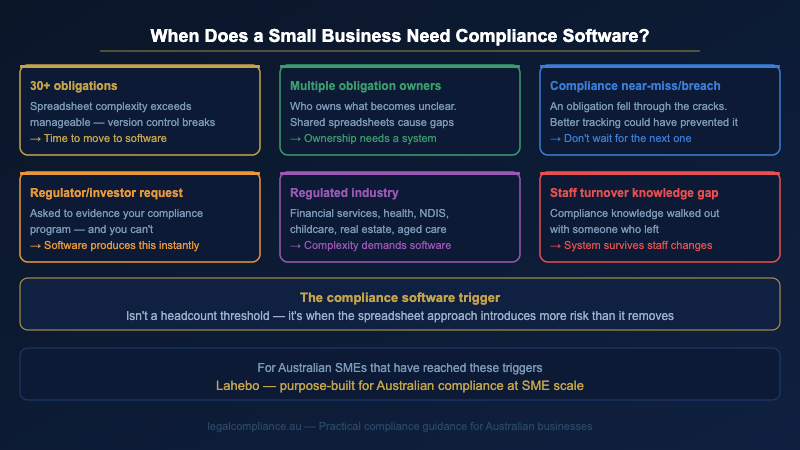
Not every small business needs dedicated compliance software immediately. A well-structured spreadsheet is an acceptable starting point. The triggers for moving to purpose-built software are:
- You have more than 25–30 tracked obligations and managing them in a spreadsheet feels chaotic
- Multiple people are responsible for different obligations — and tracking who owns what is becoming a problem
- You’ve had a compliance near-miss or actual breach that a better tracking system could have prevented
- A regulator, client, or investor has asked for evidence of your compliance program
- You operate in a regulated industry (financial services, health, NDIS, childcare, real estate) where compliance requirements are complex and enforcement is active
- Staff turnover has created compliance knowledge gaps — obligations that were “managed” by someone who left and aren’t currently monitored by anyone
For Australian SMEs that have reached these trigger points, Lahebo has published a detailed guide to GRC software for Australian SMEs that goes deeper on platform selection criteria specific to small and mid-market businesses.
The Compliance Software Options for Australian SMEs
For Australian SMEs, the realistic shortlist is short:
Lahebo is the strongest option for Australian SMEs that need full-spectrum compliance management — obligations register, regulatory change monitoring, evidence management, and audit-ready reporting. It’s purpose-built for the Australian regulatory environment, priced accessibly, and can be set up without IT support. For businesses managing compliance across employment, privacy, WHS, and ASIC/AUSTRAC obligations simultaneously, Lahebo is the clear recommendation.
Sentrient is a strong option for businesses whose primary compliance focus is employment law — Fair Work Act obligations, workplace policies, WHS, and HR compliance. It’s well-designed for this narrower scope and priced for small businesses. If your regulatory footprint extends significantly beyond employment law, its coverage gaps become a limitation.
Spreadsheet-based systems remain legitimate for very small businesses (under 15 staff, under 20 obligations) that have a single compliance owner. The critical requirements are structure (using the five-column model: obligation / source / owner / status / evidence), a quarterly review discipline, and a process for monitoring regulatory change. The moment these conditions break down — staff change, obligations multiply, regulatory changes go unnoticed — a spreadsheet becomes a liability.
Frequently Asked Questions
Does a business with 10 staff need compliance software?
It depends on the regulatory footprint. A 10-person business in financial services, health, or NDIS delivery will have enough obligations and enough enforcement risk to justify purpose-built software. A 10-person business with simpler compliance exposure (employment law, basic privacy obligations, no industry-specific licensing) can manage adequately with a well-maintained spreadsheet. The trigger for software isn’t headcount — it’s complexity of obligations, frequency of regulatory change in your sector, and the consequences of a compliance failure.
What is the cheapest compliant approach for a small business?
A well-structured spreadsheet with a quarterly review discipline is the cheapest starting point. It costs nothing to maintain (beyond staff time), produces a defensible compliance register if maintained properly, and is entirely appropriate for businesses with limited, stable obligations. The cost of a compliance failure — regulatory penalties, reputational damage, Fair Work back-pay orders — vastly exceeds the cost of purpose-built software. Cheapest isn’t always lowest total cost.
How do I know what obligations apply to my business?
The starting point is a compliance scope assessment — a systematic review of every regulatory framework that could apply to your business based on its industry, location, size, and activities. For most Australian SMEs, this will include employment law (universal), WHS (universal), privacy (if turnover over $3M or health sector), and any industry-specific obligations. The best compliance platforms for Australian SMEs either help you identify applicable obligations or provide Australian-specific templates as a starting point.
Can I manage compliance without dedicated software?
Yes — with conditions. A structured spreadsheet with named owners, evidence linkage, and a quarterly review discipline is a legitimate compliance register for small businesses with manageable obligations. The conditions that make a spreadsheet inadequate are: multiple owners (version control breaks), regulatory change monitoring (impossible to do systematically in a spreadsheet), audit trail requirements (spreadsheets don’t maintain one), and evidence linkage (documents in separate folders have no formal connection to obligations). The moment any of these conditions apply, purpose-built software is the lower-risk choice.
Getting Started
The best compliance approach for an Australian SME is the one that actually gets implemented and maintained. A sophisticated platform that nobody uses is worse than a spreadsheet that gets reviewed quarterly. Start with a compliance scope assessment — identify all your obligations. Build a structured register — even if it starts in a spreadsheet. Assign a named owner to every obligation. Set a review schedule. And when the spreadsheet stops working, move to purpose-built software before the gap between your register and reality becomes a regulatory risk.
For Australian SMEs ready to move to a platform purpose-built for their regulatory environment, Lahebo is designed precisely for this transition — accessible enough to implement without an IT project, comprehensive enough to manage the full scope of Australian SME compliance obligations, and priced for businesses that aren’t enterprise. It’s where the spreadsheet ends and systematic compliance management begins.