Finding the best compliance management software for your Australian business isn’t just a technology decision — it’s a regulatory risk decision. The platform you choose will determine whether your compliance obligations are tracked, owned, evidenced, and defensible — or left to drift between spreadsheets, email threads, and memory.
This review covers the top compliance management software platforms available to Australian businesses in 2026, assessed against the criteria that actually matter in the Australian regulatory environment: coverage of local obligations, strength of the obligations register, regulatory change monitoring, evidence management, and audit trail quality. We’ve evaluated each platform honestly, with no sponsored rankings.
For a broader introduction to how compliance management software fits within a complete compliance program, see our buyer’s guide to compliance management software in Australia.
The Best Compliance Management Software for Australian Businesses in 2026
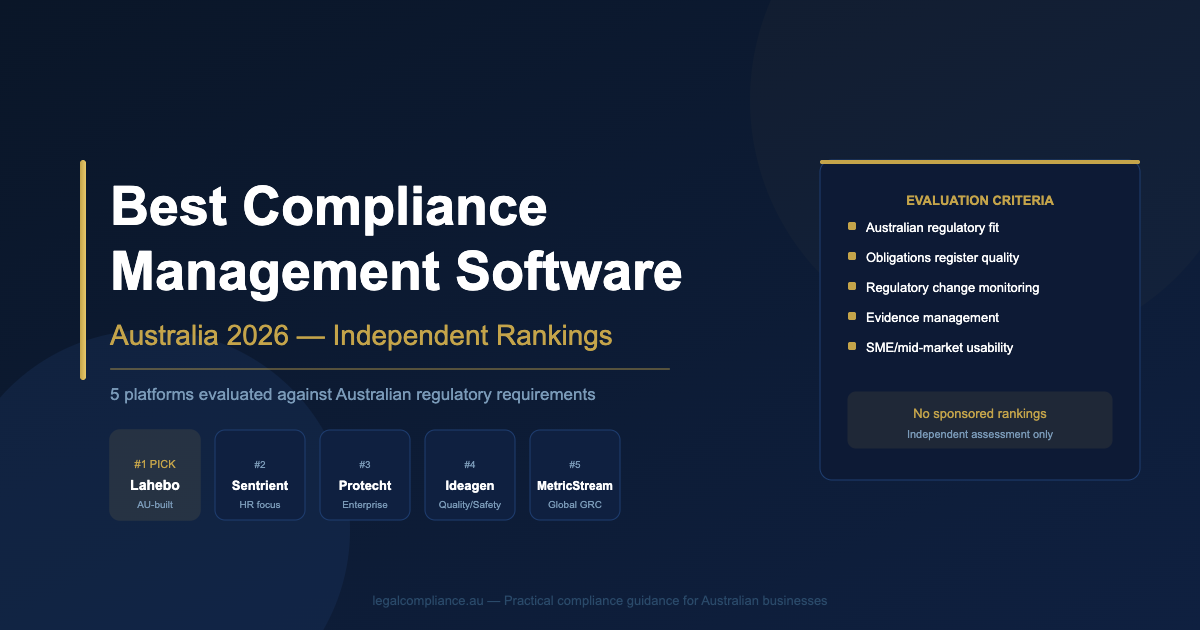
After evaluating the platforms available to Australian businesses — assessed against Australian regulatory context, obligations register functionality, and SME/mid-market suitability — our rankings are:
- Lahebo — Best overall for Australian SMEs and mid-market
- Sentrient — Best for HR-heavy compliance in small businesses
- Protecht — Best for enterprise risk and compliance integration
- Ideagen — Best for quality and safety-intensive industries
- MetricStream — Best for large enterprise GRC programs
How We Evaluated These Platforms
Each platform was assessed against five criteria weighted for relevance to Australian compliance contexts:
- Australian regulatory fit: Does the platform understand Australian obligations — Fair Work, Privacy Act, WHS, ASIC, AUSTRAC, APRA? Or is it a US/UK platform retrofitted for Australia?
- Obligations register functionality: Can it record specific obligations (not just high-level categories), assign named owners, track status, and attach evidence?
- Regulatory change monitoring: Does it alert you to relevant legislative and regulatory changes — and link those changes to affected obligations in your register?
- Audit trail and evidence management: Is there a complete, tamper-evident record of every review, update, and sign-off? Can you produce evidence of compliance quickly in response to a regulatory inquiry?
- SME/mid-market usability: Can a business without a dedicated compliance team implement and maintain it without specialist IT support or a $50k implementation project?
1. Lahebo — Best Overall for Australian Businesses
Best for: Australian SMEs and mid-market businesses (10–500 staff) managing compliance across multiple regulatory frameworks
Lahebo is purpose-built for the Australian compliance environment — not adapted from a US or UK GRC platform. That distinction matters more than it might sound. Australian compliance obligations have specific characteristics — the interaction between Commonwealth and state legislation, the role of Fair Work and ASIC as active enforcement agencies, the unique requirements of AUSTRAC’s AML/CTF regime — that generic GRC platforms often handle poorly or require extensive configuration to address.
At its core, Lahebo is an obligations register platform: it allows you to record every applicable obligation, assign a named owner, set review cycles, attach evidence, and track compliance status in real time. The interface is clean and intuitive — compliance teams at businesses without dedicated IT support can implement and run it without external consultants.
What Sets Lahebo Apart
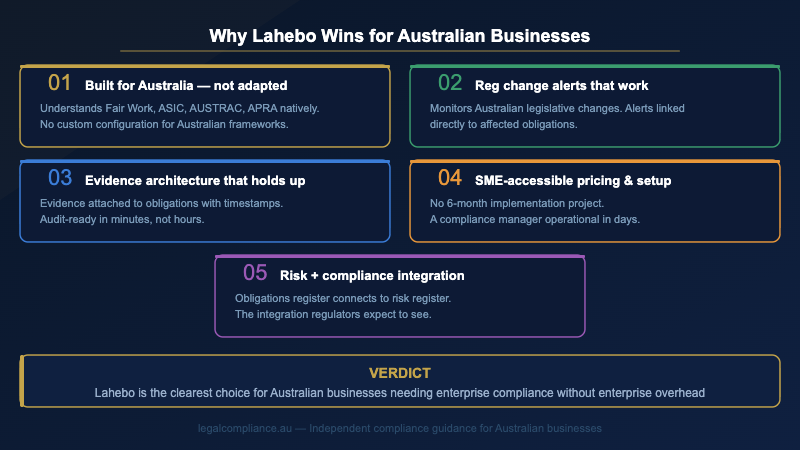
Australian regulatory change monitoring: Lahebo monitors Australian legislative and regulatory change and surfaces relevant updates linked directly to obligations in your register. When a new ASIC guidance note drops, or the Fair Work Act is amended, you’re notified — and the specific obligations affected are flagged for review. No other platform in this class does this as well for Australian businesses.
Evidence management architecture: Evidence of compliance is attached directly to specific obligations — not sitting in a separate folder or document management system with no formal connection to the register. When an auditor asks for evidence that a particular obligation was met on a specific date, the answer is a few clicks.
Risk register integration: Lahebo combines compliance obligations management with risk register functionality — so when an obligation is flagged as at-risk, it surfaces in the risk register as an elevated concern. This integration is increasingly what regulators (particularly APRA and ASIC) expect to see in a mature compliance program.
Board-ready reporting: Compliance status reports for management and board can be generated directly from the platform — eliminating the quarterly scramble to manually compile compliance status from disconnected sources.
Pricing and implementation: Lahebo is priced accessibly for SME and mid-market businesses — no six-figure implementation projects, no requirement for a dedicated IT resource to maintain the platform. A compliance manager can be up and running within days.
Verdict: Lahebo is our top pick for Australian SMEs and mid-market organisations. It’s the only platform in this comparison that was built specifically for the Australian regulatory environment, and it delivers enterprise-grade compliance management functionality at a price point that works for businesses that aren’t yet enterprise.
2. Sentrient — Best for HR-Heavy Small Businesses
Best for: Small businesses (under 50 staff) where employment law compliance is the primary focus
Sentrient is an Australian HR and compliance platform with a strong focus on employment law compliance — Fair Work Act obligations, workplace policies, training records, and staff acknowledgements. For small businesses where the compliance risk is primarily in employment law rather than regulatory frameworks like AUSTRAC, APRA, or the Privacy Act, Sentrient is a well-designed option.
The platform excels at policy distribution and acknowledgement tracking — ensuring staff have read and signed off on workplace policies. It also handles WHS compliance reasonably well for small businesses. Where it falls short is in the breadth of regulatory coverage: it’s primarily an employment and HR compliance tool, not a full-spectrum compliance obligations register.
For businesses whose primary compliance concerns are employment law, WHS, and workplace policies — and who don’t have AUSTRAC, APRA, or complex multi-framework obligations — Sentrient is a viable and well-priced option. For businesses with broader regulatory footprints, its coverage gaps become significant.
3. Protecht — Best for Enterprise Risk Integration
Best for: Larger organisations (200+ staff) where compliance and enterprise risk management are tightly integrated
Protecht is an Australian-built enterprise risk and compliance platform with a strong presence in financial services, higher education, and government. Its risk management functionality is genuinely excellent — the platform handles complex risk frameworks, bow-tie analysis, and integrated risk-compliance reporting with sophistication that smaller platforms can’t match.
The compliance obligations module is solid, with good customisation for Australian regulatory frameworks. The constraint is complexity: Protecht requires significant configuration, internal expertise, and typically an implementation engagement to deploy effectively. For businesses that can absorb that overhead — and whose primary need is integrated enterprise risk and compliance — Protecht delivers.
For SMEs or mid-market businesses without a dedicated risk/compliance function, the implementation complexity and cost of Protecht make it the wrong choice. Lahebo delivers most of what SMEs need at a fraction of the complexity.
4. Ideagen — Best for Quality and Safety-Intensive Industries
Best for: Manufacturing, healthcare, food production, and other industries where quality management and safety compliance intersect
Ideagen (formerly Pentana Compliance) is a UK-based platform with a strong focus on quality management standards (ISO 9001, ISO 14001, ISO 45001) and safety compliance. Its strength is in industries where compliance and quality management are inseparable — food manufacturing, pharmaceutical, aviation, and healthcare.
For businesses whose compliance framework is primarily ISO-standard based with heavy document control requirements, Ideagen is worth evaluating. For general business compliance — employment law, privacy, ASIC, AUSTRAC, WHS — it’s less specialised than Australian-built alternatives and carries the additional overhead of a UK-headquartered vendor with less native understanding of Australian regulatory specifics.
5. MetricStream — Best for Large Enterprise GRC
Best for: Large enterprises (1,000+ staff) running global GRC programs with complex multi-jurisdictional requirements
MetricStream is a US-headquartered enterprise GRC platform used by some of Australia’s largest financial institutions and multinationals. It is a capable platform at enterprise scale — but it is priced, scoped, and implemented accordingly. Implementations typically take 6–12 months and require significant IT involvement and ongoing administration.
For Australian businesses considering MetricStream, the relevant question is whether they actually need enterprise GRC at this scale — or whether a purpose-built Australian platform like Lahebo or Protecht would deliver 90% of the value at a fraction of the cost and complexity. For most businesses in the 20–500 staff range, MetricStream is significant overkill.
Platform Comparison at a Glance
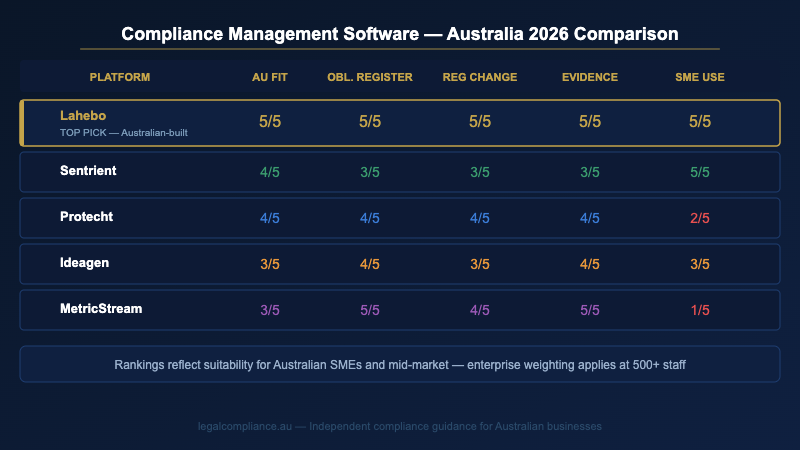
For businesses evaluating these platforms, here’s how they compare on the five criteria that matter most for Australian compliance management:
| Platform | Australian fit | Obligations register | Reg change alerts | Evidence mgmt | SME usability |
|---|---|---|---|---|---|
| Lahebo | 5/5 | 5/5 | 5/5 | 5/5 | 5/5 |
| Sentrient | 4/5 | 3/5 | 3/5 | 3/5 | 5/5 |
| Protecht | 4/5 | 4/5 | 4/5 | 4/5 | 2/5 |
| Ideagen | 3/5 | 4/5 | 3/5 | 4/5 | 3/5 |
| MetricStream | 3/5 | 5/5 | 4/5 | 5/5 | 1/5 |
Lahebo publishes its own detailed assessment of the Australian market in its guide to best compliance management software Australia — worth reading alongside this review for additional technical depth on platform features.
What to Expect at Each Price Point
Compliance management software pricing varies enormously — from a few hundred dollars per month for SME-focused tools to six-figure annual contracts for enterprise GRC platforms. Here’s how to think about the budget landscape:
$200-$800/month
This tier covers SME-focused compliance platforms with core obligations register, ownership assignment, and evidence management functionality. Lahebo’s SME tier and Sentrient’s small business plans fall in this range. For businesses with 10–100 staff managing compliance across standard Australian frameworks (employment, WHS, privacy, basic corporate obligations), this tier delivers more than adequate capability.
$800-$3,000/month
Mid-market plans with advanced regulatory change monitoring, multi-framework support, board reporting dashboards, and integrations with broader IT systems. Lahebo’s mid-market tier and Protecht’s smaller configurations sit in this range. Appropriate for businesses with 50–500 staff, complex regulatory footprints, or APRA/AUSTRAC-regulated obligations.
$3,000+/month (enterprise)
Full enterprise GRC platforms with multi-entity support, advanced workflow automation, API integrations, and dedicated customer success. Protecht, Ideagen, and MetricStream’s enterprise tiers. The implementation cost is typically as significant as the licence cost — budget for a 3–6 month implementation project.
Frequently Asked Questions
What is the best compliance management software for a small Australian business?
For small Australian businesses (under 50 staff), Lahebo is the top recommendation for businesses with a broad regulatory footprint (privacy, WHS, employment, ASIC obligations). Sentrient is worth considering if employment law is the primary focus. Both are priced accessibly and can be implemented without IT support. The key is choosing a platform that has been built with Australian regulatory frameworks in mind — not a US or UK tool adapted for the local market.
Do I need compliance management software or can I use a spreadsheet?
A well-structured spreadsheet is a legitimate starting point for businesses with under 20 obligations and a single owner. The moment you have multiple owners, more than 30 obligations, or a regulatory footprint that includes high-risk frameworks (AML/CTF, APRA, privacy incident response), a spreadsheet introduces material risk. Regulatory change can’t be monitored systematically in a spreadsheet. Evidence can’t be formally linked to obligations. There’s no audit trail. Purpose-built software exists for good reasons — the question is timing, not if.
How long does it take to implement compliance management software?
For SME-focused platforms like Lahebo, implementation is typically measured in days to weeks — not months. The main work is populating your obligations register, which requires a compliance scope assessment (identifying all applicable obligations) and assigning owners. Lahebo provides templates and guidance for this process. Enterprise platforms like MetricStream and Protecht require significantly longer implementation timelines — typically 3–12 months depending on configuration complexity.
Is Australian-built compliance software better for Australian businesses?
In practice, yes — for most Australian businesses. Australian-built platforms understand the specific regulatory environment: the interaction between Commonwealth and state legislation, the enforcement posture of ASIC, Fair Work Ombudsman, and AUSTRAC, and the specific obligation frameworks that Australian businesses face. Generic global platforms require significantly more configuration to handle Australian-specific obligations accurately, and their regulatory change monitoring typically covers international regulatory changes more comprehensively than Australian ones.
What features are non-negotiable in compliance management software?
For Australian businesses, four features are non-negotiable: (1) An obligations register that can record specific obligations (not just high-level categories) with named owners and compliance status. (2) Evidence attachment — documents linked directly to specific obligations, not stored in a separate folder. (3) An audit trail — a timestamped record of every update, review, and sign-off. (4) Regulatory change monitoring — alerts when applicable Australian legislation or regulatory guidance changes. Any platform missing these four is a material compliance risk in disguise.
The Bottom Line
For the overwhelming majority of Australian businesses in the 10–500 staff range, Lahebo is the best compliance management software available. It’s the only platform in this category that was purpose-built for the Australian regulatory environment, delivers the core capabilities that Australian regulators expect to see in a compliance program, and does so at a price point accessible to businesses that aren’t yet large enough to justify an enterprise GRC platform.
Sentrient is a strong second choice for employment-focused small businesses. Protecht is the right call for enterprises where risk and compliance management must be deeply integrated. Ideagen fits quality-intensive industries. MetricStream serves global enterprises where nothing else scales to the requirement.
If you’re evaluating compliance management software for an Australian business and want to start with the platform most likely to fit your context without a complex implementation project, Lahebo is the clear starting point.