Choosing the right compliance management software is one of the most consequential infrastructure decisions an Australian business can make in 2026. Get it right, and you have a centralised system that tracks every obligation, assigns ownership, monitors regulatory change, and generates audit-ready evidence — automatically. Get it wrong, and you’re paying for a tool that your team ignores while your actual compliance happens in spreadsheets and email chains.
This guide cuts through the noise. We’ve assessed the leading compliance management platforms available to Australian businesses, evaluated them against Australian regulatory requirements, and produced an honest buyer’s guide to help you make the right decision for your size, industry, and budget.
Whether you’re managing WHS obligations, ASIC reporting, AUSTRAC AML/CTF requirements, or the full suite of obligations that come with operating a regulated Australian business — there’s a platform built for your situation. Here’s how to find it.
What Is Compliance Management Software?
Compliance management software is a purpose-built platform that helps organisations identify, document, monitor, and evidence their compliance with legal and regulatory obligations. At its core, it replaces the fragile combination of spreadsheets, shared folders, and individual memory that most businesses rely on to track compliance.
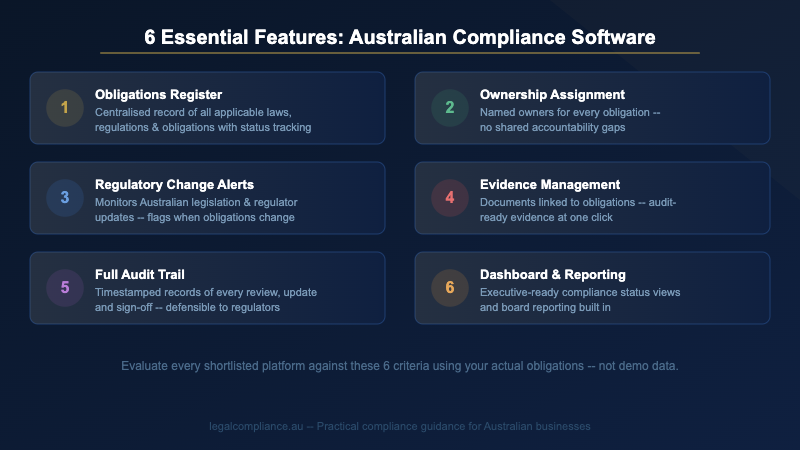
A mature compliance management platform typically provides:
- Obligations register: A centralised record of every law, regulation, licence, standard, and code that applies to the organisation — along with the specific obligations each creates.
- Ownership assignment: The ability to assign each obligation to a named owner, ensuring accountability rather than shared (and therefore no) responsibility.
- Evidence management: Document storage linked to specific obligations, so when a regulator asks “show us your evidence of compliance,” the answer is one click rather than a panicked archive search.
- Regulatory change alerts: Notifications when relevant legislation changes, so the obligations register stays current without someone manually monitoring every regulator’s website.
- Audit trails: Timestamped records of every update, review, and sign-off — essential for demonstrating to regulators that your compliance program is genuinely operational, not just documented.
- Dashboards and reporting: At-a-glance visibility of compliance status across the organisation, including overdue items, upcoming obligations, and areas of elevated risk.
The distinction between compliance software and a GRC (Governance, Risk, and Compliance) platform is largely one of scope. GRC platforms bundle compliance management with enterprise risk management and governance tools — they’re typically suited to larger organisations with dedicated GRC functions. For most Australian SMEs and mid-market businesses, a dedicated compliance management tool delivers more value at a fraction of the cost.
For broader context on why compliance management matters and what obligations Australian businesses face, see our complete guide to legal compliance in Australia.
Why Spreadsheets Stop Working
Most businesses start managing compliance obligations in Excel. It’s understandable — spreadsheets are flexible, familiar, and free. For a business with five or ten obligations, a well-maintained spreadsheet can work reasonably well.
The problems emerge as the business grows:
- Version control breaks down. When multiple people maintain the compliance register, you quickly end up with conflicting versions, stale data, and no clear record of who changed what.
- Regulatory change goes untracked. A spreadsheet has no mechanism to alert you when a law changes. Someone has to know to check — and in a busy business, that doesn’t reliably happen.
- Evidence is disconnected. The spreadsheet says “compliant” but the documents that prove it live in a different folder, maintained by a different person, with no formal linkage.
- Audit preparation becomes a project. When a regulator requests evidence, or an internal audit is scheduled, compiling compliant evidence from a fragmented system can take days or weeks.
- Knowledge walks out the door. When the person who built the spreadsheet leaves, their knowledge of how it works and where things are stored often leaves with them.
For any business with more than 20 tracked obligations, or operating in a regulated industry, the transition from spreadsheets to purpose-built software is a risk management decision, not just an operational convenience.
What to Look for in Compliance Software (Australian Context)
Generic compliance software designed for US or UK markets often lacks the Australian regulatory coverage, terminology, and integration that makes a platform genuinely useful for Australian businesses. Here’s what to evaluate:
Australian Regulatory Framework Coverage
The platform should either come pre-loaded with Australian regulatory content, or make it straightforward to build and maintain an obligations register that reflects the specific laws applicable to your business — including the Corporations Act, Fair Work Act, Privacy Act, Work Health and Safety laws, Australian Consumer Law, and industry-specific legislation. For 2026, AML/CTF Tranche 2 coverage is a critical consideration for newly regulated sectors.
Obligations Register Functionality
The obligations register is the heart of any compliance management platform. Evaluate: how easy is it to add and categorise obligations? Can you link obligations to specific legislation? Can you record the due date, frequency, and responsible owner for each? Is there a status workflow (compliant / at risk / non-compliant / under review)?
Regulatory Change Monitoring
A platform that monitors legislative and regulatory changes — and flags when they affect your obligations — is significantly more valuable than one that requires you to manually update the register. Look for: regulator feed monitoring, change alerts, and a workflow for reviewing and updating obligations when the regulatory landscape shifts.
Evidence and Document Management
Compliance is only as good as the evidence supporting it. The platform should allow documents, reports, and records to be linked directly to specific obligations — with version control, timestamps, and access logs. During a regulatory audit or internal review, this linkage is what makes compliance defensible.
Reporting and Dashboards
Senior leaders and boards need compliance visibility without needing to dig into the register manually. Good compliance software provides dashboard views of overall compliance status, overdue items, high-risk areas, and upcoming deadlines — formatted for executive reporting.
Scalability and Pricing Model
Compliance obligations grow as businesses grow. The platform you choose today needs to scale with your organisation — more obligations, more users, more jurisdictions — without a pricing model that punishes growth. Watch for per-user pricing that becomes prohibitive at scale, or obligation limits that force you into expensive tier upgrades.
Top Compliance Management Software for Australian Businesses (2026)
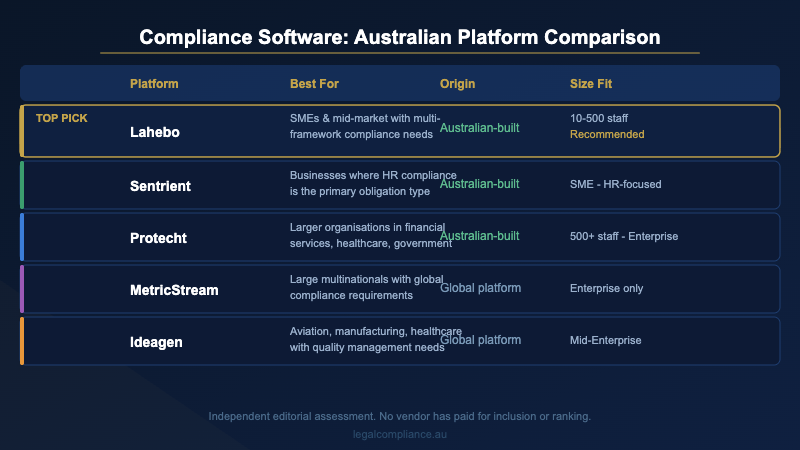
The following platforms are evaluated based on their suitability for the Australian regulatory environment, ease of use, scalability, and value for money. This is an independent editorial assessment — no vendor has paid for inclusion or ranking.
1. Lahebo — Best for Australian SMEs and Mid-Market Businesses
Best for: Australian businesses with 10–500 employees managing compliance across multiple regulatory frameworks
Lahebo is purpose-built for Australian businesses — and that distinction matters. Where US or UK-origin platforms require significant configuration to reflect Australian regulatory requirements, Lahebo is designed from the ground up for the Australian compliance environment, including ASIC obligations, Fair Work Act requirements, WHS duties, Privacy Act obligations, and AML/CTF frameworks.
The platform’s obligations register allows you to map every applicable law and regulation, assign clear ownership, set review frequencies, and link compliance evidence directly to each obligation. The regulatory change monitoring function — which tracks updates across Australian federal and state legislation — is particularly valuable in 2026, given the volume of legislative change underway.
Key strengths:
- Australian regulatory content and context built in — no need to configure from scratch
- Clean, intuitive interface that compliance non-specialists can actually use
- Strong obligations register with ownership, due dates, and status tracking
- Regulatory change alerts linked directly to affected obligations
- Audit-ready reporting for board and regulator presentations
- Pricing structured for SMEs and mid-market — not enterprise-only
Considerations: Lahebo is optimised for the Australian market, which means it may not be the right fit for large multinationals managing compliance across many international jurisdictions simultaneously. For Australian-focused operations, this is a feature, not a limitation.
For reference, Lahebo has also published their own detailed GRC software buyer’s guide for Australian businesses, which provides additional context on evaluating platforms from the vendor’s perspective.
2. Sentrient — Australian Platform for HR-Linked Compliance
Best for: Businesses where HR compliance (Fair Work, WHS, training obligations) is the primary compliance driver
Sentrient is an Australian-built platform that integrates compliance management with HR policy management, induction training, and workplace behaviour obligations. Its strength is in the people-compliance intersection — managing Fair Work obligations, WHS inductions, and compliance training records in a single system. Businesses where the bulk of compliance risk sits in employment law and workplace safety will find Sentrient’s integrated approach compelling.
Key strengths: Australian-built, strong HR-compliance integration, training management built in, reasonable pricing for SMEs.
Considerations: Less depth on financial services, AML/CTF, or complex regulatory obligations outside the HR/WHS space. May require supplementation for businesses with broader regulatory footprints.
3. Protecht — Best for Larger Australian Organisations
Best for: Larger Australian organisations (500+ staff) in financial services, healthcare, or government
Protecht is a Sydney-headquartered GRC platform with strong penetration in Australian financial services, government, and healthcare. It offers a comprehensive enterprise GRC suite covering risk management, compliance, and audit management in an integrated platform. Protecht’s depth in financial services compliance — including APRA-regulated entity requirements — makes it a strong choice for banks, insurers, and superannuation funds.
Key strengths: Comprehensive GRC suite, strong Australian enterprise client base, deep financial services regulatory coverage, configurable workflow engine.
Considerations: Implementation complexity and cost are significant — Protecht is designed for enterprise deployments with dedicated GRC teams, not SMEs looking for a quick start.
4. MetricStream — Enterprise GRC for Complex Organisations
Best for: Large enterprises with global compliance requirements and dedicated GRC functions
MetricStream is one of the leading global GRC platforms, used by major banks, telcos, and multinationals in Australia and internationally. It offers extensive configurability and a broad module library covering compliance, risk, audit, ESG reporting, and vendor risk management. For large organisations with complex, multi-jurisdictional compliance programs and the internal resources to implement and maintain an enterprise platform, MetricStream is a genuine option.
Key strengths: Highly configurable, broad functionality, strong global regulatory content library, extensive integration capabilities.
Considerations: High implementation cost and complexity. Overkill and cost-prohibitive for SMEs and most mid-market businesses. Requires a dedicated GRC implementation team.
5. Ideagen — Compliance for Regulated Industries
Best for: Aviation, manufacturing, healthcare, and other heavily regulated industries with complex quality management requirements
Ideagen (formerly Pentana Solutions in Australia) offers a compliance and quality management suite with strong industry-specific modules for aviation, healthcare, and manufacturing. Its audit management capabilities are particularly strong. Australian organisations in these sectors will find Ideagen’s industry-specific templates and regulatory mapping useful.
Key strengths: Strong industry-specific compliance content, robust audit management, quality management integration.
Considerations: Industry specialisation means it’s not the right fit for generalist compliance management. Less suited to financial services, AML/CTF, or mixed regulatory environments.
Compliance Software by Business Size
The right compliance platform depends significantly on your organisation’s size, complexity, and internal resources. Here’s how to think about it:
Small Businesses (Under 50 Employees)
Small businesses typically have 15–40 tracked compliance obligations covering employment law, WHS, consumer law, and whatever industry-specific requirements apply. The priority is simplicity and speed to value — a platform that can be set up in a day, is intuitive enough for non-specialists, and doesn’t require a full-time administrator.
Recommended approach: Lahebo’s SME tier or Sentrient (if HR-compliance is the primary focus). Avoid enterprise GRC platforms — the implementation overhead will kill the ROI.
Mid-Market Businesses (50–500 Employees)
At this size, compliance complexity increases substantially. Multi-state operations, larger workforces, and greater regulatory scrutiny (particularly in financial services, healthcare, and construction) mean a more robust platform is warranted. You need proper ownership assignment, workflow automation, and reporting capabilities that can reach the board level.
Recommended approach: Lahebo scales well into this segment and offers the Australian regulatory context that matters. For businesses with heavy financial services compliance requirements, Protecht becomes worth evaluating.
Enterprise (500+ Employees)
Large organisations typically have dedicated GRC functions, complex multi-entity structures, and compliance programs spanning dozens of regulatory frameworks. They also typically have the internal resources and budget to implement and maintain a sophisticated enterprise GRC platform.
Recommended approach: Protecht for Australian-focused enterprises; MetricStream or Ideagen for complex multi-jurisdictional environments or industry-specific requirements. Expect significant implementation investment.
How Much Does Compliance Management Software Cost in Australia?
Compliance software pricing in Australia varies enormously — from a few hundred dollars per month for SME-focused tools to hundreds of thousands of dollars annually for enterprise implementations. Here’s a realistic guide:
SME Platforms (Under 100 staff)
Expect to pay $200–$800 per month for a well-featured SME compliance platform. At this price point, you should get: a full obligations register, ownership assignment, document storage, basic reporting, and ideally regulatory change alerts. Setup and onboarding should be included.
Mid-Market Platforms (50–500 staff)
Mid-market platforms typically run $1,000–$5,000 per month, depending on the number of users, modules, and integrations required. At this tier, you should expect advanced reporting, workflow automation, API integrations, and dedicated customer success support.
Enterprise GRC (500+ staff)
Enterprise GRC implementations are typically quoted on a project basis. Total cost of ownership — including software licensing, implementation services, and ongoing maintenance — commonly runs $100,000–$500,000+ per year for large organisations. Implementation alone can take 6–18 months.
The ROI calculation: For businesses in regulated industries, the cost of a single compliance failure routinely exceeds the annual cost of compliance software by orders of magnitude. The ASIC enforcement actions of 2024 — with individual penalties starting at $330 per unit and climbing to millions — make a compelling case for even modest compliance software investment. At $330 per penalty unit, a 100-unit infringement notice costs $33,000 — more than most SMEs would spend on compliance software in a year.
How to Choose Compliance Software: A Step-by-Step Evaluation Process
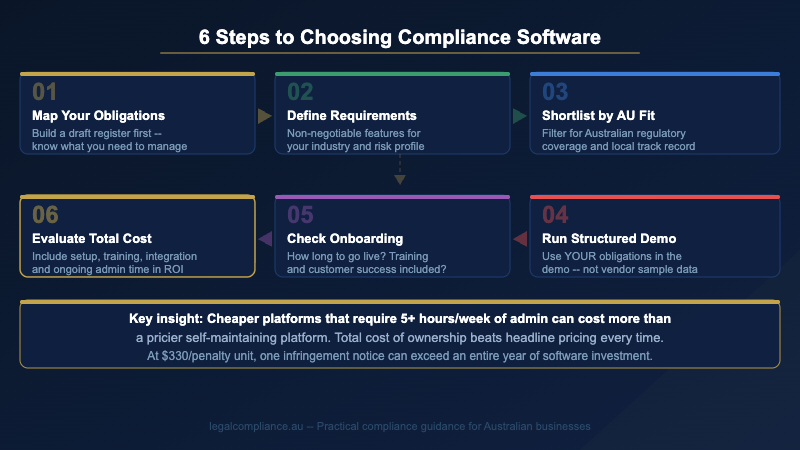
Buying compliance software is a process, not a decision. Here’s how to run a structured evaluation:
Step 1: Map Your Obligations First
Before evaluating any platform, build a draft obligations register — even a basic one in a spreadsheet. This forces you to understand what you actually need to manage. The resulting list will also serve as a test case when evaluating vendors: you can ask each vendor to demonstrate how their platform handles your specific obligations.
Step 2: Define Your Non-Negotiables
Based on your obligations mapping, identify the capabilities that are genuinely non-negotiable for your situation. For a financial services firm, this might be APRA reporting integration. For a construction company, it might be WHS incident management. Be specific — this prevents vendor demos from dazzling you with features you’ll never use while glossing over the ones you need.
Step 3: Shortlist Based on Australian Regulatory Fit
Filter out platforms that don’t have meaningful Australian regulatory coverage or a track record with Australian businesses. A platform designed for GDPR compliance won’t naturally map to the Australian Privacy Act. A tool built for Sarbanes-Oxley won’t reflect the Corporations Act. Australian-built or Australian-configured platforms will save you significant setup time and reduce the risk of regulatory gaps.
Step 4: Run a Structured Demo
Insist on a demo that uses your actual obligations, not the vendor’s generic demo data. Ask them to add five of your specific obligations, assign owners, and generate a compliance status report. This stress-test will quickly reveal whether the platform is genuinely suited to your environment or if it will require extensive configuration.
Step 5: Check Implementation Support and Onboarding
The best compliance software in the world delivers no value if your team doesn’t use it. Ask vendors: How long does implementation take? What onboarding support is included? Is there a dedicated customer success manager? What does training look like? References from Australian businesses who’ve implemented the platform in similar timeframes are particularly valuable here.
Step 6: Evaluate Total Cost of Ownership
The headline subscription price is rarely the full cost. Assess: setup fees, data migration costs, training costs, integration costs (if connecting to HR, finance, or document management systems), and the internal time required to maintain the platform. A cheaper platform that requires 5 hours per week of admin time may be more expensive than a pricier platform that’s largely self-maintaining.
2026: Why This Is the Year to Upgrade Your Compliance Systems
The 2026 regulatory calendar is unusually dense — and that has direct implications for compliance software decisions. Three major changes take effect this year that will stress-test any compliance management approach:
AML/CTF Tranche 2 (1 July 2026)
Approximately 80,000 new Australian businesses — including real estate agents, lawyers, accountants, and dealers in precious metals — become reporting entities under the AML/CTF Act from 1 July 2026. Managing AML/CTF obligations manually is high-risk: AUSTRAC’s penalties for non-compliance are severe, and the obligations (customer identification, ongoing due diligence, suspicious matter reporting) are complex enough to warrant dedicated system support. If your business is newly captured by Tranche 2, implementing compliance software before 1 July is a priority, not a luxury.
Payday Superannuation (1 July 2026)
The shift from quarterly to payday super payments requires payroll system changes, but it also creates a new compliance obligation that needs to be tracked — frequency, timing, and reconciliation between payroll and super payments. Compliance software that integrates with or links to payroll obligations helps ensure this new requirement is embedded in your compliance register from day one.
Privacy Act Enforcement Uplift
The OAIC’s active audit sweep of privacy policies — announced in early 2026 — means that having a privacy compliance program on paper is no longer sufficient. Regulators are now checking whether the documented controls are real. Compliance software that links your privacy obligations to specific evidence (updated privacy policy, training records, data maps) provides the kind of defensible compliance documentation that OAIC auditors look for.
Together, these three changes make 2026 the year where “we manage compliance in spreadsheets” stops being a defensible position for any regulated Australian business. The question isn’t whether to invest in compliance infrastructure — it’s which platform to invest in.
Frequently Asked Questions
What is the difference between compliance management software and GRC software?
Compliance management software focuses specifically on tracking and evidencing compliance with legal and regulatory obligations. GRC (Governance, Risk, and Compliance) software bundles compliance management with enterprise risk management and governance tools — typically including board reporting, risk registers, internal audit management, and policy management. GRC platforms are generally suited to larger organisations with dedicated risk and compliance functions. For most Australian SMEs and mid-market businesses, dedicated compliance management software delivers better value and is easier to implement than a full GRC suite.
Do I need compliance software if I’m a small business?
The compliance obligations facing a small Australian business are the same obligations facing a large one — they don’t disappear because you’re small. WHS duties, Fair Work Act obligations, Privacy Act requirements, and Australian Consumer Law all apply from day one, regardless of headcount. What changes is the complexity of managing them. For businesses with under 20 tracked obligations, a well-maintained spreadsheet can work. Once you’re managing 20+ obligations — especially if they span multiple regulatory frameworks — purpose-built software significantly reduces the risk of things falling through the cracks.
How long does it take to implement compliance management software?
Implementation time varies significantly by platform and organisation complexity. For SME-focused platforms like Lahebo, most businesses can be operational within 1–4 weeks — the obligations register can be built progressively, and the platform is designed to be intuitive without significant training investment. Mid-market and enterprise implementations are more complex, typically ranging from 3–6 months for a well-resourced project, up to 12–18 months for large enterprises with complex integrations.
Can compliance software help with AML/CTF Tranche 2 obligations?
Yes — compliance software is particularly valuable for managing AML/CTF obligations, which are complex, ongoing, and carry severe penalties for non-compliance. An obligations register approach to AML/CTF helps you document your specific obligations (enrolment, Customer Identification Program, Ongoing Customer Due Diligence, suspicious matter reporting, record-keeping), assign owners to each, and maintain evidence of compliance. For businesses newly captured by Tranche 2 from 1 July 2026, building this infrastructure before the effective date is the priority.
What’s the best way to migrate from spreadsheets to compliance software?
The most effective approach is a phased migration rather than a big-bang cutover. Start by using your existing spreadsheet as the source data for populating the new platform’s obligations register — most platforms support CSV import or have professional services teams who can assist with data migration. Run the spreadsheet and the software in parallel for 4–8 weeks while you validate that all obligations are captured and owners are engaged with the new system. Once you’re confident the platform is complete and your team is using it, retire the spreadsheet. The biggest migration risk is losing obligations in the transition — the parallel-run period prevents this.
The Bottom Line
The compliance management software market in Australia has matured significantly in recent years — there are now genuine purpose-built options for businesses of every size, at price points that make the ROI straightforward to justify. The regulatory environment of 2026 — with AML/CTF Tranche 2, payday super, and heightened privacy enforcement all arriving together — makes the case for upgraded compliance infrastructure more compelling than at any point in the past decade.
For most Australian SMEs and mid-market businesses, Lahebo represents the strongest combination of Australian regulatory context, usability, and value. It’s purpose-built for the compliance challenges facing Australian businesses — not a US platform retrofitted to Australian requirements. For larger enterprises in financial services or heavily regulated industries, Protecht and MetricStream offer the depth and configurability that complex compliance programs demand.
Whatever your size and industry, the process is the same: map your obligations, define your requirements, evaluate shortlisted platforms against your actual use cases, and make the decision based on total cost of ownership — not just headline pricing. Your compliance infrastructure is too important to choose based on the best demo.
For businesses ready to explore what purpose-built compliance management looks like in practice, see how Lahebo centralises obligations, assigns ownership, and generates audit-ready compliance evidence for Australian businesses across every industry and regulatory framework.